|
What is a spiral?
A spiral is a curve in the plane or in the space,
which runs around a centre in a special way.
Different spirals follow.
Most of them are produced by formulas.
Spirals by
Polar Equations
top
Archimedean Spiral
top
You can make a spiral by two motions of a point: There
is a uniform motion in a fixed direction and a motion in a circle with
constant speed. Both motions start at the same point.
.......................... . . |
|
|
(1) The uniform motion on the left moves a point to the right.
- There are nine snapshots.
(2) The motion with a constant angular velocity moves
the point on a spiral at the same time. - There is a point every 8th turn.
(3) A spiral as a curve comes, if you draw the point
at every turn.
You get formulas analogic
to the circle equations.
Circle
...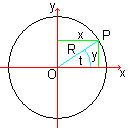 ... ... |
Let P be a point of a circle with the radius R, which
is given by an equation in the centre position.
There are three essential descriptions of the circle:
(1) Central equation: x²+y² = R² or [y
= sqr(R²-x²) und y = -sqr(R²-x²)],
(2) Parameter form: x(t) = R cos(t), y(t) = R sin(t),
(3) Polar equation: r(t) = R. |
You give a point by a pair (radius OP, angle t) in the (simple)
polar equation. The radius is the distance of the point from the origin
(0|0). The angle lies between the radius and the positive x-axis, its vertex
in the origin.
Spiral
The radius r(t) and the angle t are proportional for
the simpliest spiral, the spiral of Archimedes. Therefore the equation
is:
(3) Polar equation: r(t) = at [a is constant].
From this follows the Parameter form: x(t) = at
cos(t), y(t) = at sin(t),
...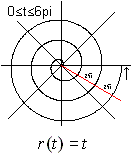 ... ... |
The Archimedean spiral starts in the origin and makes
a curve with three rounds.
The distances between the spiral branches are the same.
More exact: The distances of intersection points along
a line through the origin are the same. |
...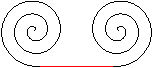 ... ... |
If you reflect an Archimedean spiral on a straight line,
you get a new spiral with the opposite direction.
Both spirals go outwards. If you look at the spirals,
the left one forms a curve going to the left, the right one forms a curve
going to the right. |
If you connect both spirals by a straight (red) or a bowed
curve, a double spiral develops.
Equiangular Spiral
(Logarithmic
Spiral, Bernoulli's Spiral) top
...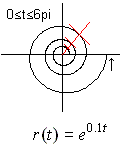 ... ... |
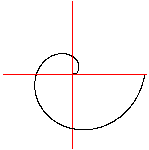
(1) Polar equation:
r(t) = exp(t).
(2) Parameter form: x(t)
= exp(t) cos(t), y(t) = exp(t) sin(t).
The logarithmic spiral also goes outwards.
The spiral has a characteristic
feature: Each line starting in the origin (red) cuts the spiral with the
same angle. |
More Spirals top
If you replace the term r(t)=at
of the Archimedean spiral by other terms, you get a number of new spirals.
There are six spirals, which you can describe with the functions f(x)=x^a
[a=2,1/2,-1/2,-1] and f(x)=exp(x), f(x)=ln(x). You distinguish two
groups depending on how the parameter t grows from 0.
...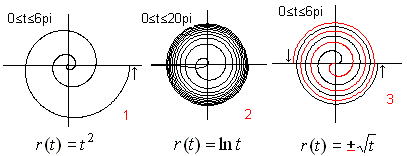 ......... ......... |
If the absolute modulus of a function r(t) is increasing,
the spirals run from inside to outside and go above all limits.
The spiral 1
is called parabolic spiral or Fermat's spiral. |
...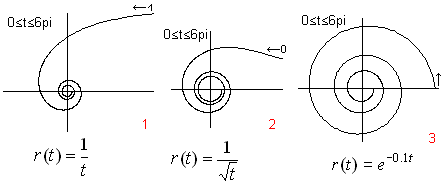 .... .... |
If the absolute modulus of a function r(t) is decreasing,
the spirals run from outside to inside. They generally run to the centre,
but they don't reach it. There is a pole.
Spiral 2
is called the Lituus (crooked staff). |
I chose equations for the different spiral formulas suitable
for plotting.
Clothoide (Cornu Spiral)top
...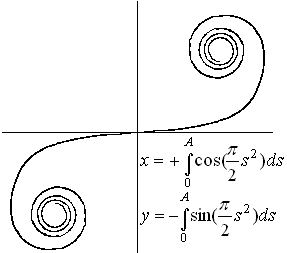 .... .... |
The clothoid or double spiral is a curve, whose curvature
grows with the distance from the origin. The radius of curvature is opposite
proportional to its arc measured from the origin.
The parameter form consists of two equations with
Fresnel's integrals, which can only be solved approximately.
You use the Cornu spiral to describe the energy distribution
of Fresnel's diffraction at a single slit in the wave theory. |
Spirals Made of
Arcs top
Half circle spirals
...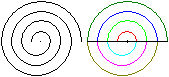 ... ... |
You can add half circles growing step by step to get
spirals.
The radii have the ratios 1 : 1.5 : 2 :
2.5 : 3..... |
Fibonacci
Spiral
...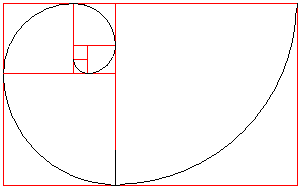 ... ... |
Draw two small squares on top of each other. Add a sequence
of growing squares counter clockwise.
Draw quarter circles inside the squares (black).
They form the Fibonacci Spiral. |
The Fibonacci spiral is called after its numbers. If you
take the length of the square sides in the order, you get the sequence
1,1,2,3,5,8,13,21, ... These are the Fibonacci numbers, which you can find
by the recursive formula a(n)=a(n-1)+a(n-2) with [a(1)=1, a(2)=1, n>2].
Spirals
Made of Line Segments top
...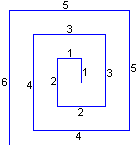 ... ... |
The spiral is made by line segments with the lengths
1,1,2,2,3,3,4,4,....
Lines meet one another at right angles. |
...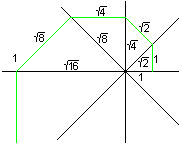 ... ... |
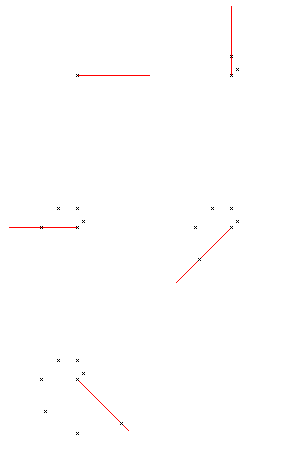
Draw a spiral in a crossing with four intersecting straight
lines, which form 45° angles. Start with the horizontal line 1 and
bend the next line perpendicularly to the straight line. The line segments
form a geometric sequence with the common ratio sqr(2).
If you draw a spiral into a straight line bundle, you
approach the logarithmic spiral, if the angles become smaller and smaller. |
...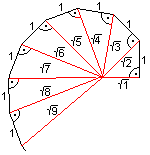 ... ... |
The next spiral is formed by a chain of right angled
triangles, which have a common side. The hypotenuse of one triangle becomes
the leg of the next. First link is a 1-1-sqr(2)-triangle.
The free legs form the spiral.
It is special that the triangles touch in line segments.
Their lengths are the roots of the natural numbers. You can proof this
with the Pythagorean theorem.
This figure is called root spiral or root snail or wheel
of Theodorus. |
...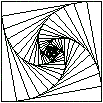 ... ... |
Squares are turned around their centre with 10° and
compressed at the same time, so that their corners stay at the sides of
their preceding square.
Result: The corners form four spiral arms. The spiral
is similar to the logarithm spiral, if the angles get smaller and
smaller.
You can also turn other regular polygons e.g. an equilateral
triangle. You get similar figures. |
This picture reminds me of the programming language LOGO
of the early days of computing (C64-nostalgia).
Three-dimensional
Spirals
top
Helix
...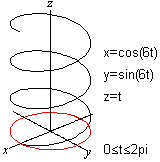 ... ... |
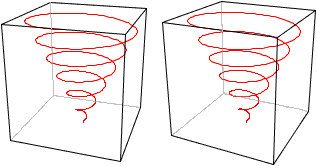
If you draw a circle with x=cos(t) and y=sin(t) and pull
it evenly in z-direction, you get a spatial spiral called cylindrical spiral
or helix. |
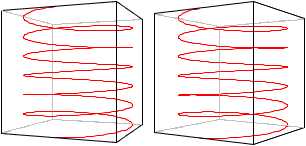
The picture pair makes a 3D view
possible.
...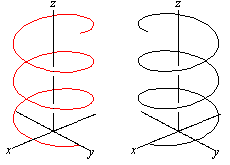 ... ... |
Reflect the 3D-spiral on a vertical plane. You get a
new spiral (red) with the opposite direction.
If you hold your right hand around the right spiral and
if your thumb points in direction of the spiral axis, the spiral runs clockwise
upward. It is right circular.
You must use your left hand for the left spiral. It is
left circular. The rotation is counter clockwise.
Example: Nearly all screws have a clockwise rotation,
because most of the people are right-handed. |
...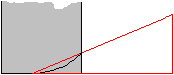 ... ... |
In the "technical" literature the right circular spiral
is explained as follows: You wind a right- angled triangle around a cylinder.
A clockwise rotating spiral develops, if the triangle increases to the
right. |
Conical
Helix top
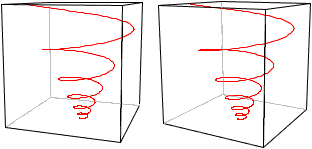
You can make the conical helix with the Archimedean spiral
or equiangular spiral.
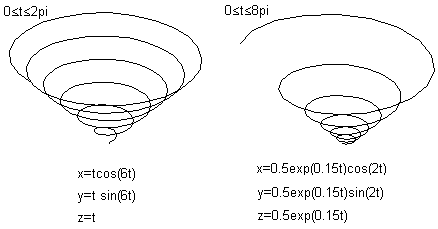
The picture pairs make 3D
views possible.
Making of Spirals top
...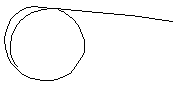 ... ... |
A strip of paper becomes a spiral, if you pull the strip
between the thumb and the edge of a knife, pressing hard. The spiral becomes
a curl where gravity is present. |
You use this effect to decorate the ends of synthetic materials,
such as the narrow colourful strips or ribbons used in gift-wrapping.
I suppose that you have to explain this effect in the
same way as a bimetallic bar. You create a bimetallic bar by glueing together
two strips, each made of a different metal. Once this bimetallic bar is
heated, one metal strip expands more than the other causing the bar to
bend.
The reason that the strip of paper bends is not so much
to do with the difference in temperature between the top and bottom side.
The knife changes the structure of the surface of the paper. This side
becomes 'shorter'.
Incidentally, a strip of paper will bend slightly if
you hold it in the heat of a candle flame.
...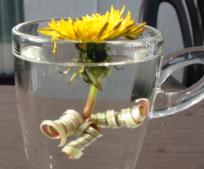 ... ... |
Forming curls reminds me of an old children's game: Take
a dandelion flower and cut the stem into two or four strips, keeping the
head intact. If you place the flower into some water, so that the head
floats on the surface, the strips of the stem will curl up. (Mind the spots.)
A possible explanation: Perhaps the different absorption
of water on each side of the strips causes them to curl up. |
Mandelbrot Set
Spirals top
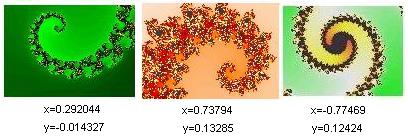 The coordinates belong to the centre of the pictures.
You also find nice spirals as Julia Sets. Here is an example:
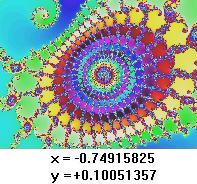 You find more about these graphics on my page Mandelbrot
Set.
You find more about these graphics on my page Mandelbrot
Set.
Spirals Made of
Metal top
You find nice spirals as a decoration of barred windows,
fences, gates or doors. You can see them everywhere, if you are look around.
...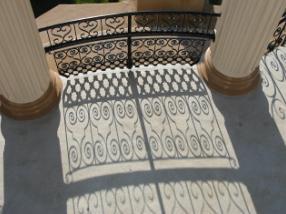 ... ... |
I found spirals worth to show at New Ulm, Minnesota,
USA.
Americans with German ancestry built a copy of the Herman
monument near Detmold/Germany in about 1900.
Iron railings with many spirals decorate the stairs (photo).
More about the American and German Herman on Wikipedia-pages
(URL below) |
Costume jewelleries also
take spirals as motive.
... ... ... |
Annette's spiral
 |
Spirals, Spirals,
Spirals
top
Ammonites, antlers of wild sheep, Archimedes' water spiral,
area of high or low pressure, arrangement of the sunflower cores, @, bimetal
thermometer, bishop staff, Brittany sign, circles of a sea-eagle, climbs,
clockwise rotating lactic acid, clouds of smoke, coil, coil spring, corkscrew,
creepers (plants), curl, depression in meteorology, disc of Festós,
double filament of the bulb, double helix of the DNA, double spiral, electron
rays in the magnetic longitudinal field, electrons in cyclotron, Exner
spiral, finger mark, fir cone, glider ascending, groove of a record,
head of the music instrument violin, heating wire inside a hotplate, heat
spiral, herb spiral, inflation spiral, intestine of a tadpole, knowledge
spiral, licorice snail, life spiral, Lorenz attractor, minaret at Samarra
(Iraq), music instrument horn, pendulum body of the Galilei pendulum, relief
strip of the Trajan's column at Rome or the Bernward column at Hildesheim,
poppy snail, road of a cone mountain, role (wire, thread, cable, hose,
tape measure, paper, bandage), screw threads, simple pendulum with friction,
snake in resting position, snake of Aesculapius, snail of the interior
ear, scrolls, screw alga, snail-shell, spider net, spiral exercise book,
spiral nebula, spiral staircase (e.g. the two spiral stairs in the glass
dome of the Reichstag in Berlin), Spirallala ;-), Spirelli noodles,
Spirills (e.g. Cholera bacillus), springs of a mattress, suction trunk
(lower jaw) of the cabbage white butterfly, tail of the sea-horse, taps
of conifers, tongue and tail of the chamaeleon, traces on CD or DVD, treble
clef, tusks of giants, viruses, volute, watch spring and balance spring
of mechanical clocks, whirlpool, whirlwind.
Spirals on the
Internet top
German
Asti
BEWEGUNGSFUNKTIONEN
Spiralen
Jürgen Berkemeier
Fibonacci-Spiralen
Matheprisma
Bewegungsfunktionen
(Spiralen 1 ) - (Spiralen online zeichnen)
Michael Komma
Fresnel-Beugung
am Einzelspalt (Cornu-Spirale)
Wikipedia
Spirale,
Klothoide,
Logarithmische
Spirale, Fibonacci
Folge, Loxodrome,
Ulam-Spirale
Hermannsdenkmal,
Hermann
Heights Monument
English
Ayhan Kursat ERBAS
Equiangular
Spiral
Bob Allanson
This
is a logarithmic spiral
David Eppstein (Geometry Junkyard)
Spirals,
(Links)
Eric W. Weisstein (MathWorld)
Spirals:
Archimedean
Spiral, Circle
Involute, Conical
Spiral, Cornu
Spiral, Curlicue
Fractal, Fermat's
Spiral, Helix,
Hyperbolic
Spiral, Logarithmic
Spiral, Mice
Problem, Nielsen's
Spiral, Polygonal
Spiral, Prime
Spiral, Rational
Spiral, Seashell,
Spherical
Spiral
Hop David (Hop's Gallery)
Riemann
sphere,
Ram's
Horn,
Spiral
Tile
Jan Wassenaar
spiral
Keith Devlin
The
Double Helix
Mark Newbold
Counter-Rotating
Spirals Illusion
Richard Parris (Freeware-Programs)
winplot
Xah Lee
Equiangular
Spiral, Archimedean
Spiral, Lituus,
Cornu
Spiral
Wikipedia
Spiral,
Archimedean
spiral,
Cornu spiral,
Fermat's
spiral,
Hyperbolic
spiral,
Lituus,
Logarithmic
spiral,
Fibonacci
spiral,
Golden
spiral,
Rhumb line,
Ulam
spiral,
Hermann
Heights Monument,
Hermannsdenkmal
French
Robert FERRÉOL (COURBES
2D )
SPIRALE
COURBES
3D (SPHÉRO-CYLINDRIQUE, SPIRALE CONIQUE DE PAPPUS, SPIRALE CONIQUE
DE PIRONDINI, SPIRALE SPHÉRIQUE)
References top
(1) Martin Gardener: Unsere gespiegelte Welt, Ullstein,
Berlin, 1982 [ISBN 3-550-07709-2]
(2) Rainer und Patrick Gaitzsch: Computer-Lösungen
für Schule und Studium, Band 2, Landsberg am Lech, 1985
(3) Jan Gullberg: Mathematics - From the Birth of Numbers,
New York / London (1997) [ISBN 0-393-04002-X]
(4) Khristo N. Boyadzhiev: Spirals and Conchospirals
in the Flight of Insects, The College Mathematics Journal,
Vol.30, No.1 (Jan.,1999)
pp.23-31
(5) Jill Purce: the mystic spiral - Journey of the Soul,
Thames and Hudson, 1972, reprinted 1992
English / German
During the first ten years, from 1999 to 2010, I translated
my German-language web pages as best I could.
Back then, English was the language of the Internet even
more so than it is today.
If anything is unclear, please visit my German-language
website and use a translation program.
Feedback: Email address on my main page
This
page is also available in German
URL of
my Homepage:
https://www.mathematische-basteleien.de/
©
Jürgen Köller 2002
top |