|
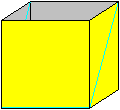
What is a Flexatube?
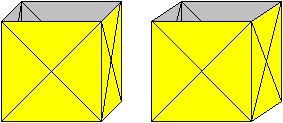
3D-picture
A flexatube is a puzzle made
of paper. Four squares form a cube which is open underneath and above in
the simplest case. The four sides and the diagonals of the squares are
folds.
The aim is to turn inside out by foldings only. This should
be the result:
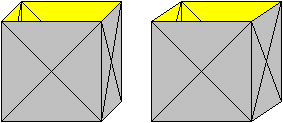
Folding a sock is a simpler exercise ;-).
The flexatube has the name
flexitube
in D.Mitchell's booklet (1). I also found flexotube.
The flexatube is a classic among the puzzles and belongs
to the flexagons or is related to them. They were found by Arthur H. Stone
in the 1930s. They became popular by Gardner's articles and books.
There are several variations and further developments
on flexatubes. You find some at D. Mitchell (1).
Making of a Flexatube
top
It is simple to build them.
The colours yellow and grey in the drawings are to support
the descriptions.
>Take a white sheet of paper A4.
...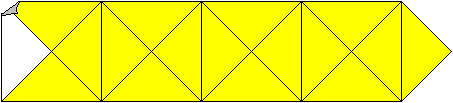 ... ... |
>Draw a strip of four squares with the side 5cm and their
diagonals as seen on the left.
>Add a quarter square on the right.
>Cut out the strip.
>Go over the lines with an empty ball pen in order to
fold the paper at the lines more easily. |
>Glue the jutting quarter triangle on the right on the white
field on the left. This leads to a ring.
>Form the cube shape.
Solution top
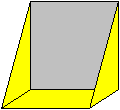
1st part
1
2
|
Then it must look like this.
 |
3
... ... ...
|
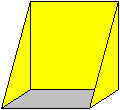
Turn over the paper so that the grey square is horizontal.
|
4
|
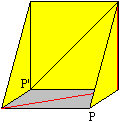
Fold on the red lines. They are valleys.
In other words: Lay point P on point P'.

|
5
|
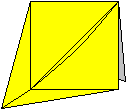
Then it must look like this.
|
6
...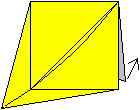 ... ... |
There is a half square at the reverse side. Turn it backwards
so that it is perpendicular to the yellow square.
|
7
...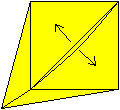 ... ...
|
There is a slit in the centre. Widen it in direction
of the arrows.
|
8
...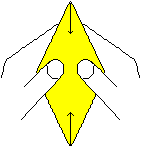 ... ... |
This is a drawing of my page about the paper boat. It
fits here.
Widen the slit and lay the upper and the lower parts on
each other.
|
9
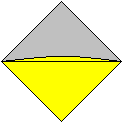
|
Then it must look like this.
There has developed a bag above.
|
2nd
part
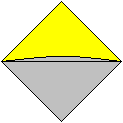
10
|
Turn over the paper.
There is also a bag on the reverse side, but the colours
have changed.
|
From now on make all steps
in reverse.
11
...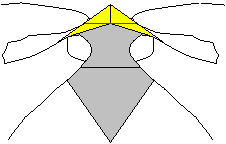 ... ... |
Put your thumbs into the bag and push in the squares
on both sides at the red lines with your index finger. |
12
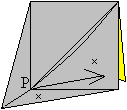 |
Then it must look like this.
Pull out both x-sheets (meeting in P).
|
13
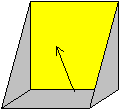 |
Then it must look like this.
Pull out the horizontal grey square.
|
14
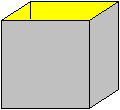 |
You get the solved flexatube in the end.
|
A Second Solution
top
......
Step 9
|
There is a simple solution in booklet (1).
The 2nd
part (step 11 to 14) is easily to understand:
Put the yellow corner below into the grey bag above and
unfold the paper.
1st part:
You get step 1 to 9 by retracing the putting in and unfolding.
This is not easy.
|
Flexatubes
on the Internet top
English
Eric W. Weisstein
Flexatube
Harold V. McIntosh
General
Tetraflexagon, Flexatube, or Bregdoid
Laszlo Bardos
Flexatube
Serhiy Grabarchuk (Age of Puzzles)
Arthur
Stone's Flexatube
YouTube
solving
the tritetraflexatube
Comments top
The flexatube has features of a good puzzle.
>It is simple to look at and to make it.
>Everybody can solve it after some or more minutes. But
then you don't know how to repeat the solution.
>If you want to reproduce the solution, you must recognize
structures and go forward systematically.
>Turning back folds is a principle of this puzzle. This
leads to a solution in two parts.
>There are several independent solutions.
References
top
(1) David Mitchell: The Magic of Flexagons, Norfolk England
1998 (ISBN 1 899618287)
(2) Martin Gardner: The Second Scientific American Book
of Mathematical Puzzles and Diversions, Simon & Schuster (1961)
(3) Martin Gardner: Wheels, Life, and other Mathematical
Amusements, Freeman (1983) New York
(3') Martin Gardener: Martin Gardner's mathematische
Denkspiele, Hugendubel München 1987 (ISBN 3 88034 323 3)
(Die Kombinatorik des Papierfaltens, Seite 32ff.)
Feedback: Email address on my main page
This
page is also available in German.
URL of
my Homepage:
https://www.mathematische-basteleien.de/
©
2005 Jürgen Köller
top |